 yeonghyeon · Apr 12, 2026
AI Readiness for Small Business — Data, APIs, and What to Do Now

Hi, I'm yeonghyeon, leading development at 3Min API.
These days, AI is talked about as if it can solve every problem. But from what I see on the ground, many teams haven't even completed their basic digital transformation yet. Telling these teams to "adopt AI" is like telling someone without a driver's license to go buy a car.
Today, I want to cut through the hype and talk about what small businesses actually need to prepare for the AI era.
What AI Actually Is Today
First, we need to understand exactly where AI stands right now.
The AI we use today — large language models, or LLMs — has been trained on massive amounts of text and images, reaching a level where it can understand and respond to natural language. Pay attention to the word "understand" here. AI's understanding is based on probability.
The way I think about it is this: if you have a sentence like "The weather today is ___," AI looks at all the sentences it learned from and probabilistically selects the most likely word to fill that blank. Words like "sunny," "cloudy," or "hot" rank high in probability, while "purple" gets pushed to the bottom.
Let me give you a few examples.
- Translation: If you ask AI to translate "Thank you" into French, it finds that "Merci" is the highest-probability match from its training data. This isn't fundamentally different from how we learn a foreign language through repeated exposure and association.
- Summarization: Give it a long document and ask for a summary, and AI probabilistically determines the importance of each sentence and extracts the key points. It's similar to an experienced assistant picking out the essentials from a report.
- Question answering: Ask "What's the population of Tokyo?" and it finds contexts in its training data where Tokyo and population appear together, then generates the most probable answer.
What's interesting is that this approach isn't all that different from how humans think. We also make judgments about new information based on what we already know. The difference is that AI sometimes produces plausible-sounding answers even for things not in its training data. This is called hallucination.
For example, what happens if you ask "Who won the 2030 Nobel Prize in Physics?" It hasn't happened yet, but AI can probabilistically combine plausible names and achievements to answer as if it were fact. When there's no correct answer in the training data, it constructs the highest-probability combination.
Understanding these limitations is the first step to using AI effectively.
What AI Still Struggles With
Consistency — Producing the Same Result Every Time
One of AI's biggest limitations is that it can't always give the same answer to the same question. That's because it's probability-based.
In casual conversation, this isn't a problem. But in business, it's a different story.
Here's an example. Give AI your March sales data and ask "Calculate the margin rate excluding returns, based on pre-discount cost" three times, and you might get three different answers. The first time: 23.5%. The second: 24.1%. The third: 22.8%. As conditions get more complex, AI interprets the calculations differently each time, and the results vary.
For things like invoice amounts, inventory counts, and tax calculations — areas where you need exactly the same result every time — this is a serious problem. If the amount on an invoice you send to a partner changes every time, you'll lose trust.
The Solution: Tools and AI Working Together
So is there no way around this? There is.
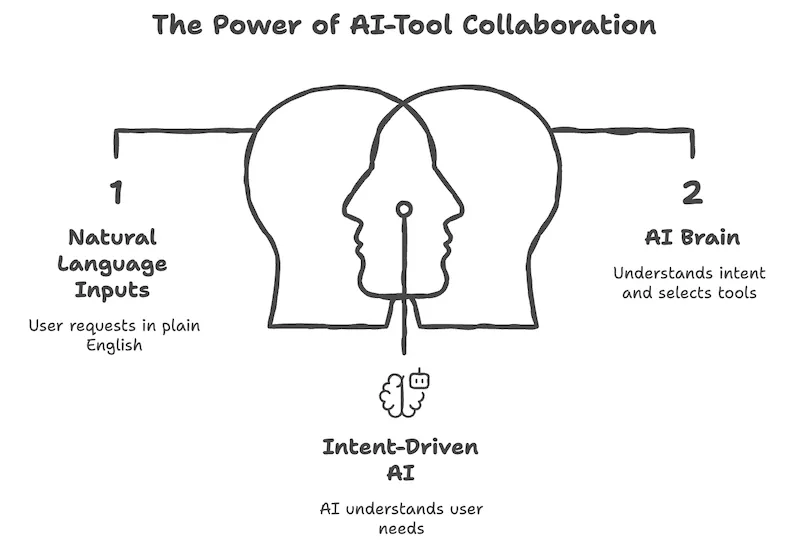
The key idea is this: what if there are tools that always produce the same result, and AI can use those tools?
A calculator always answers 2 when you ask 1+1. Query a database for "total March revenue" and you always get the same number. These tools guarantee consistent results.
Combine that with AI's strengths, and you get a powerful synergy. AI understands diverse human requests, selects the right tool, and executes it. The input (human requests) varies, but the output (tool results) is always consistent.
This is exactly what the AI industry calls an "Agent." It's AI going beyond just conversation to using tools to perform actual work. One of the technologies making this possible is MCP (Model Context Protocol). Think of MCP as a standard way for AI to communicate with external tools.
The Limits of Memory
Another limitation of AI is that its memory is limited in scope.
Think of it like a consultant who forgets everything from previous meetings each time. They can only make judgments based on the information given in the current session, so they may miss past context.
For example, imagine asking AI to "build our company website." Getting an initial result is somewhat feasible. But a few months later, when you ask "add a signup feature and integrate it with the existing order page," problems arise. AI doesn't remember how it originally structured the website or what changes were made along the way. It works only from the partial information currently visible, which can lead to results that don't fit the existing architecture.
There are ways to mitigate this.
- Small teams: Document things well along the way so AI can understand them easily. If you leave text records of your project's structure, the reasoning behind decisions, and change history, AI can grasp the context much more accurately.
- Larger teams: You can leverage technologies like RAG (Retrieval-Augmented Generation). In simple terms, it's like creating an AI-accessible library of your internal documents that AI can search through when needed. However, this approach involves significant cost, so it's more realistic to consider it once you've reached a certain scale.
What Small Teams Can Do
Now that we've covered AI, let's think about what small teams can actually do in practice.
Consider the revolutions that changed human history. When the Agricultural Revolution happened, not everyone invented new farming tools. Most people learned how to use the new tools and increased their productivity.
It was the same when automobiles first appeared. Companies with capital and technical expertise jumped into manufacturing cars. But far more businesses and individuals learned to drive and put them to use. Logistics companies replaced horse-drawn carts with trucks, doctors used cars for house calls, and merchants could sell their goods across a wider area.
The AI era isn't much different. Companies with massive capital are building AI models themselves. But for most businesses, what matters isn't building AI — it's preparing to use AI effectively.
So what exactly should you prepare? It comes down to two things: tools and data.
Preparing your tools enables AI to directly assist with your work. Preparing your data enables AI to make accurate decisions. With both of these in place, AI can finally understand your business and provide real, practical help.
Preparing Your Tools
Imagine you're a blacksmith in the Middle Ages. You have the skill to forge farming tools, but what if you don't have the raw materials or equipment? No matter how skilled you are, you can't produce anything.
AI is the same. No matter how capable it is, without tools to access and work with your business data, it can't provide meaningful help.
Here's the good news: many services have already started integrating with AI. The tools you use frequently — Claude, ChatGPT, Gemini — already connect with services like Notion, Google Drive, and Gmail. Tell AI "summarize last week's meeting notes" and it can go find them in Notion and summarize them for you. Adding events to your calendar or drafting emails is also possible from within AI.
How is this possible? The answer is that each service exposes its features in a format that AI can understand. The most widely used technology for this right now is MCP. It plays a role similar to an API. If an API is "a gateway to call a specific function," MCP is "a standard protocol that lets AI discover and use any tool." Since AI understands natural language, it's much better at using text-based tools (APIs) than clicking through screens (UIs).
This leads to a crucial question: Is your business ready to participate in this integration?
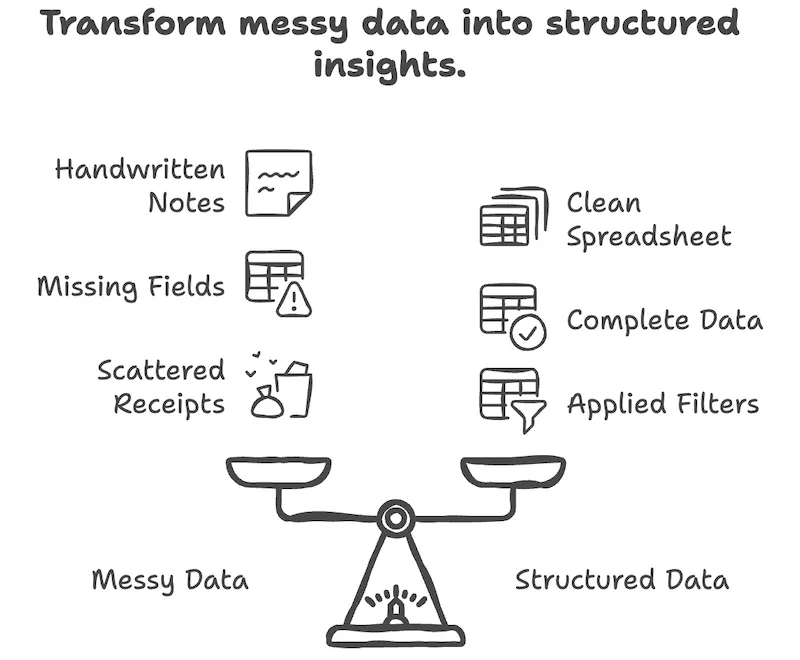
To get there, you need two things: well-structured data and APIs. For AI to make accurate decisions and produce consistent results, certain areas of your business must have systems that guarantee consistency. Well-organized, structured data and APIs to work with that data are exactly those systems.
Of course, current AI technology is far more advanced than this. But just as not everyone could afford a car when automobiles first appeared, not everyone needs to — or should — jump straight to the latest AI technology. It's expensive, and it's often unnecessary.
Starting with spreadsheets is perfectly fine. But when your data grows beyond what spreadsheets can handle and you see signs of real growth, that's when you should consider adopting a database and APIs. Since this involves cost, it's wise to start with small experiments before committing.
In summary, for small teams that haven't yet undergone digital transformation, there's a necessary step between growth and AI adoption: organizing your data and preparing tools that AI can use.
Preparing Your Data
Data preparation breaks down into two parts. The first is turning your business subjects into data, and the second is documenting your business definitions and workflows.
Turning Your Business into Data
The importance of structuring your data cannot be overstated.
Imagine you're the manager of a massive warehouse. If you need to store and ship various types of goods, you naturally need to think about how to organize them first. You'd label each item, separate shelves by category, and record locations.
Business data works the same way. Let me give you a concrete example.
Say you're a wine seller. Managing wine types, prices, and inventory isn't hard. But what if your business grows and you start selling cheese that pairs well with wine? And then accessories like wine glasses and decanters? As your product range expands, systematic data management becomes essential.
More importantly, you'll eventually need to make business decisions based on accumulated sales data — like whether to add new products or drop underperformers.
Expressing this as data is simpler than you might think. The term might be unfamiliar, but in a format called JSON, it looks like this:
{
  "orderId": "ORD-2026-0412",
  "customer": "Alex Chen",
  "address": "123 Main St, Austin, TX",
  "items": [
    { "category": "Wine", "name": "Château Margaux 2020", "price": 189.00 },
    { "category": "Cheese", "name": "Brie", "price": 24.50 }
  ],
  "totalPrice": 213.50,
  "saleDate": "2026-04-12"
}
If we convert the JSON above into a spreadsheet for easier reading, it looks like this:
| Order ID | Customer | Category | Product | Price | Sale Date |
|---|---|---|---|---|---|
| ORD-2026-0412 | Alex Chen | Wine | Château Margaux 2020 | $189.00 | 2026-04-12 |
| ORD-2026-0412 | Alex Chen | Cheese | Brie | $24.50 | 2026-04-12 |
It's the same information, just in different formats. JSON is easy for computers (and AI) to work with, while spreadsheets are easy for humans to read. When your data is structured like this, you can analyze revenue by category, monthly sales trends, and product popularity rankings. It's a simple example, but you'd be surprised how many businesses don't even have this level of preparation.
Before the AI era, designing data structures like this required specialized expertise. But now, you can have a conversation with AI and build the right data structure for your business together. Just ask: "We sell wine and cheese — how should we organize our order data?"
Documenting Your Business Logic
The second part is organizing your overall business operations in a way that AI can easily understand.
Imagine you run a restaurant. If it's small, the owner probably knows every recipe by heart. But as you scale, you need to quantify those recipes and create manuals. You can't afford to shut down just because your head chef leaves, right? And if circumstances force you to sell the business, having good documentation is essential. We call this a system.
From the same perspective, when your business grows and you need to prepare for AI integration, these documents become an excellent foundation for AI to learn from.
The core idea is like a table of contents in a book. You create broad categories, break them down into subcategories, and repeat this process to build detailed documentation.
Example: Wine Business Document Structure
- Order Processing
- New order intake procedure
- Payment verification and processing
- Inventory deduction rules
- Shipping
- Packaging standards (wine/cheese separate)
- Carrier integration methods
- Returns and exchange procedures
- Customer Management
- Tier-based benefits
- Inquiry response guidelines
This structure is useful for discussing with AI even before any formal integration. You can ask: "Look at our business documents and find areas for improvement in our order processing workflow." Later, when you're ready for full AI integration, these documents serve as training data.
The tool you use for documentation — Notion, Obsidian, Word, Excel — doesn't matter. What matters is the habit of capturing your business knowledge in text.
Imagining AI Integration
If you've followed along this far, let's imagine what AI integration might look like, step by step.
The Starting and Growth Phase
Picture a situation where your business data is structured and you have APIs in place.
- Business data with partners flows through APIs, stored safely and reliably.
- When you need new data integrations, you can work with AI to quickly design data structures and APIs.
- As data accumulates steadily, analytics and insights — like revenue trends and customer behavior — become possible.
This process takes less time than you might think. For example, 3Min API was built to support exactly this starting phase. It provides features as MCP tools that AI can understand, so you can connect it to Claude and get guidance on how to begin through conversation.
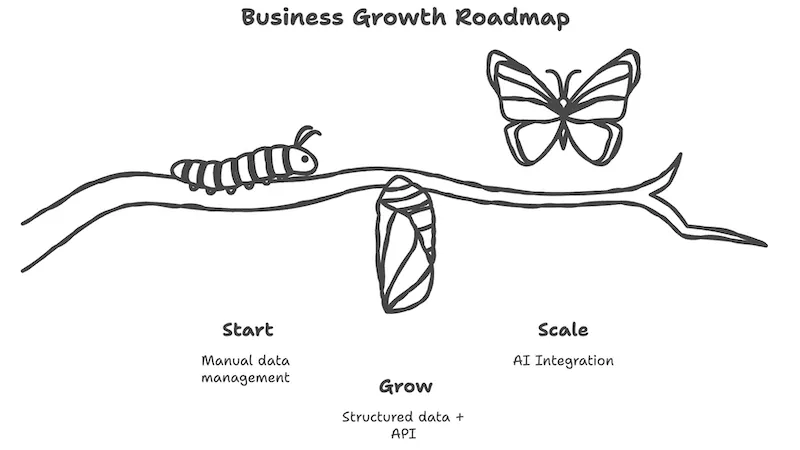
The Scaling Phase
When signs of explosive growth appear, it's time to seriously consider building your own systems.
This is where everything you've prepared pays off. Structured data becomes the foundation for your new system's database design. API integration experience informs your system-to-system architecture. Documented business logic serves as your requirements specification.
For example, if you've been collecting order data through APIs, you can carry that data structure directly into your own system and integrate it with an ERP or CRM. If your business documents are well organized, you can ask AI: "Design an order processing system based on these documents."
What would take months without preparation can be shortened to weeks when you're ready. That's because AI can reference your data structures and business documents to assist with both system design and implementation.
Wrapping Up
What small businesses need to prepare for the AI era isn't as daunting as you might think.
- Structure your data. Whether it's spreadsheets or databases, organizing your business information systematically is the first step.
- Document your business. Capturing how your business operates in text creates the foundation for collaborating with AI.
- Prepare your tools and connections. As you grow, having APIs in place allows AI to integrate naturally with your business.
When automobiles changed the world, the biggest beneficiaries weren't the people who built cars — they were the people who learned to drive first. The AI era is no different. The small preparations you make today will create a significant advantage tomorrow.
Related Posts
What Is a Database? A Beginner's Guide for Spreadsheet Users
From paper ledgers to spreadsheets to databases — a relational database primer for non-developers, told through the growth story of a small wine shop.
Your Data Deserves a Plan — How We Think About Storage, Format, and Growth
Why we chose JSON as the backbone of 3Min API, what that means for your data, and how to turn API records into real business insights.
Building a ChatGPT App with the Apps SDK: MCP, OAuth, and Notes from Submission
How we built and submitted 3Min API as a ChatGPT App. We picked the standard MCP SDK only (no OpenAI-specific wrapper), implemented OAuth 2.1 (RFC 7591/8414/9728) plus an API Key path for CLI tools, and learned to mark destructiveHint/openWorldHint conservatively after one rejection. The same code covers Claude Connectors as well.